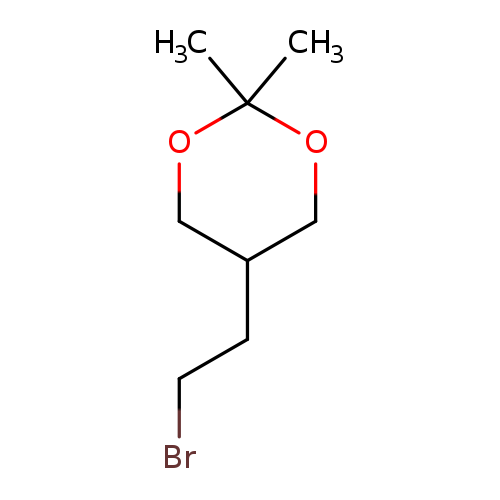
The compound 5-(2-Bromoethyl)-2,2-dimethyl-1,3-dioxane is a versatile building block in chemical synthesis, commonly used for the introduction of a 2-bromoethyl functionality in organic molecules. This compound can be employed as a precursor for the synthesis of various organic compounds, including pharmaceuticals, agrochemicals, and materials.In organic synthesis, 5-(2-Bromoethyl)-2,2-dimethyl-1,3-dioxane can serve as a starting material for the preparation of diverse heterocyclic compounds through cyclization reactions. The presence of the bromoethyl group enables further functionalization via cross-coupling reactions, nucleophilic substitution, or palladium-catalyzed transformations.Additionally, this compound is utilized in the construction of complex molecular architectures due to its high reactivity and compatibility with a wide range of synthetic methodologies. Its unique structure and reactivity make it a valuable tool for accessing novel chemical entities with diverse properties and functionalities.In summary, the application of 5-(2-Bromoethyl)-2,2-dimethyl-1,3-dioxane in chemical synthesis offers a strategic approach for the design and synthesis of molecular scaffolds with potential applications in various fields of chemistry and beyond.







![O=C(C=Cc1ccccc1)C=Cc1ccccc1.O=C(C=Cc1ccccc1)C=Cc1ccccc1.O=C(C=Cc1ccccc1)C=Cc1ccccc1.[Pd].[Pd]](https://img.angenechemical.com/storage/3a59/3a5932eec850ab245f6f4d4a7f9497f9.png)
(Cl)Cl)c1c(C)cc(cc1C)C](https://img.angenechemical.com/storage/6693/66939a3f08a27d2b6717c3194e00970b.png)