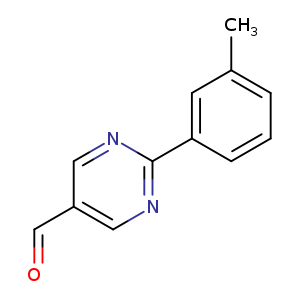
2-(3-Methylphenyl)-5-pyrimidinecarboxaldehyde, also known as $name$, is a versatile compound widely utilized in chemical synthesis. This compound serves as a key building block for the creation of various advanced materials, pharmaceuticals, and agrochemicals due to its unique chemical properties.In chemical synthesis, 2-(3-Methylphenyl)-5-pyrimidinecarboxaldehyde acts as a crucial intermediate in the preparation of diverse organic compounds. It participates in numerous reactions, including condensation, reduction, and oxidation processes, to form complex molecular structures with specific functionalities. With its aromatic ring and carbonyl group, this compound serves as a valuable starting material for the synthesis of biologically active molecules, functional polymers, and specialty chemicals.Additionally, 2-(3-Methylphenyl)-5-pyrimidinecarboxaldehyde plays a vital role in the development of novel drugs, herbicides, and insecticides. By incorporating this compound into the molecular design of pharmaceuticals and agrochemicals, researchers can enhance the efficacy, selectivity, and safety profiles of the final products. Its structural features make it an essential component in the creation of potent bioactive compounds targeting various biological pathways.Overall, 2-(3-Methylphenyl)-5-pyrimidinecarboxaldehyde is a valuable tool in chemical synthesis, enabling scientists to design and produce a wide range of functional molecules with applications in pharmaceutical, agricultural, and material science industries.







![O=C(C=Cc1ccccc1)C=Cc1ccccc1.O=C(C=Cc1ccccc1)C=Cc1ccccc1.O=C(C=Cc1ccccc1)C=Cc1ccccc1.[Pd].[Pd]](https://img.angenechemical.com/storage/3a59/3a5932eec850ab245f6f4d4a7f9497f9.png)
(Cl)Cl)c1c(C)cc(cc1C)C](https://img.angenechemical.com/storage/6693/66939a3f08a27d2b6717c3194e00970b.png)